
Zitan WangCO2 Reduction Catalyst Microenvironments Caudill 008 (919) 843-6852 B.A. in Chemistry and Computer Science Grinnell College, 2025 Research Summary: Zitan’s research focuses on optimizing the electrocatalytic reduction of carbon dioxide into green fuels, such as methanol. As part of the Center for Hybrid Approaches in Solar Energy to Liquid Fuels (CHASE), he investigates how engineering a catalyst's microenvironment via an ionomer overlayer can modulate local reaction conditions to trap key intermediates and enhance selectivity. Personal Summary: Outside of the lab, Zitan enjoys reading, cooking Chinese food, playing video games, and crafting a daily latte with his espresso machine. |

|
Contributing Author
Nano Letters
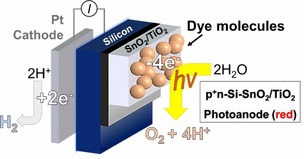
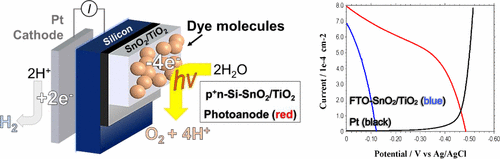
Mesoporous metal oxide film electrodes consisting of derivatized 5.5 μm thick SnO2 films with an outer 4.3 nm shell of TiO2 added by atomic layer deposition (ALD) have been investigated to explore unbiased water splitting on p, n, and p+n type silicon substrates. Modified electrodes were derivatized by addition of the water oxidation catalyst, [Ru(bda)(4-O(CH2)3PO3H2)-pyr)2], 1, (pyr = pyridine; bda = 2,2′-bipyridine-6,6′-dicarboxylate), and chromophore, [Ru(4,4′-PO3H2-bpy) (bpy)2]2+, RuP2+, (bpy = 2,2′-bipyridine), which form 2:1 RuP2+/1 assemblies on the surface. At pH 5.7 in 0.1 M acetate buffer, these electrodes with a fluorine-doped tin oxide (FTO) back contact under ∼1 sun illumination (100 mW/cm2; white light source) perform efficient water oxidation with a photocurrent of 1.5 mA/cm2 with an 88% Faradaic efficiency (FE) for O2 production at an applied bias of 600 mV versus RHE ( ACS Energy Lett., 2016, 1, 231−236). The SnO2/TiO2–chromophore–catalyst assembly was integrated with the Si electrodes by a thin layer of titanium followed by an amorphous TiO2 (Ti/a-TiO2) coating as an interconnect. In the integrated electrode, p+n-Si–Ti/a-TiO2–SnO2/TiO2|-2RuP2+/1, the p+n-Si junction provided about 350 mV in added potential to the half cell. In photolysis experiments at pH 5.7 in 0.1 M acetate buffer, bias-free photocurrents approaching 100 μA/cm2 were obtained for water splitting, 2H2O → 2H2 + O2. The FE for water oxidation was 79% with a hydrogen efficiency of ∼100% at the Pt cathode.